Dan's plan for and subsequent abandonment of cold sleep
The Door into SummerDan's plan for and subsequent abandonment of cold sleep marks a decisive reversal: he first tries to leap over the troubles of his present into the year 2000, then chooses to live through the intervening years and confront Miles and Belle. The decision begins as a meticulously negotiated insurance arrangement for himself and Pete, but a doctor's challenge and Dan's recognition of what he would leave behind turn the proposed escape into a choice to stay and fight. Decades later, the collapse of Master Insurance exposes the fragility of the financial future he had tried to secure.
The Long Sleep plan
Dan goes to Mutual Assurance Company and states plainly that he wants the Long Sleep. He is not willing to separate his fate from Pete's: when an executive describes preserving the cat alive in hypothermia, Dan insists that Pete has a name and that both of them are to sleep. He will pay an additional amount, but argues that Pete can share his coffin and should not be charged the full human fee. The contract is eventually set at fifteen percent of the human fee, with Pete covered by a separate agreement.
Dan's decision also entails a series of choices about how to pay for care, how long to sleep, how to invest his money, and what should happen if he dies without waking. He settles on the year 2000, thirty years away. Recent history already feels dizzying to him: he recalls wars, the downfall of communism, the Great Panic, artificial satellites, and the change to atomic power. He fears that a longer sleep would leave him wholly out of touch, yet sees thirty years as a span he might cross and still understand.
His investment strategy is deliberately aggressive. Dan rejects government bonds and other conservative choices because he expects inflation to erode their value. He keeps his Hired Girl stock, puts cash into common stocks, favors automation, and chooses a San Francisco fertilizer company experimenting with yeast and edible algae, anticipating that population growth will make food more valuable. He places the remaining money in the company's managed trust fund.
The starkest provision concerns death in suspension. Mutual claims that the odds are better than seven in ten that he will survive thirty years of cold sleep, but Dan elects to leave every cent to the company trust fund if he dies. That arrangement makes him a potential heir to the assets of other clients who choose the same option and do not survive, while the company retains its share. Dan understands the wager as a gamble in which the house takes its percentage; he chooses the highest possible return without hedging against loss. His willingness to accept that exposure makes the agreement more attractive to the executive negotiating Pete's care.
Legal safeguards and the doctor's intervention
The arrangements are not only financial. Dan understands that a person in cold sleep is legally alive but helpless, and that court consent is required. Mutual produces four copies of nineteen documents; Dan signs until his fingers cramp, and a messenger carries the papers away while he undergoes his physical examination. He never sees the judge. The procedure translates his future incapacity into a network of forms, custody agreements, and financial provisions before he has even entered the sanctuary.
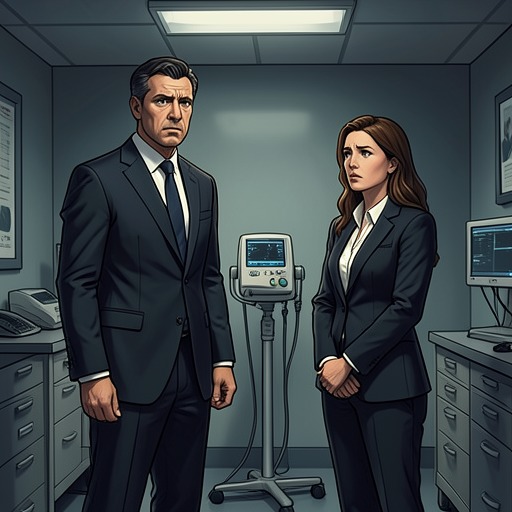
At the examination, the physician recognizes Dan's condition as a drinking binge and warns that he can still veto the cold sleep. He injects Dan and gives him a drink intended to make him sober, telling him to reconsider whether he means to run away from his troubles or stand up to them. He also orders Dan to avoid alcohol, eat lightly, and return the next day for a final check. The intervention interrupts the bureaucratic momentum of the plan: even after signing the papers, Dan is not yet committed, and the doctor makes the moral question behind the transaction explicit.
Dan initially takes the warning seriously enough to avoid drinking. Instead of going for alcohol, he and Pete stop at a drive-in. Dan orders chicken for himself and hamburger and milk for Pete, then takes the cat for a short walk while they wait. He recognizes that he wants food and sleep rather than another drink, and that he feels better after the injection. The ordinary meal gives him room to think; the question is no longer simply how to arrange a successful sleep, but whether sleep is the future he actually wants.
The decision to stay and fight
A letter to Ricky brings Dan's change of mind into focus. He has placed his Hired Girl stock certificate in an envelope for her, but realizes that if he dies or otherwise becomes unable to protect it, the certificate could eventually return to Miles and Belle. The possibility forces him to confront what his absence would mean. He decides he will not take the cold-sleep deal: sobering up and the doctor's lecture have stiffened his resolve, and he means to stay and fight rather than run away.
The stock is not merely a financial asset in this decision. Dan sees that it gives him the right to examine the company's books and investigate its affairs. If Miles and Belle again use a hired guard to exclude him, he can return with a lawyer, a deputy sheriff, and a court order. He also believes that litigation could make enough trouble to discourage the Mannix people from buying the company out. The certificate thus becomes a practical instrument of resistance, and his decision to preserve it is bound up with his decision to remain present.
Dan still sends the certificate to Ricky, but makes the transfer easy to reverse. He avoids using the assignment form printed on the back, which would require a minor to assign the stock back to him; instead, a separate sheet can simply be torn up. He encloses the certificate and assignment note in a smaller envelope, places that inside a letter addressed to Ricky at the Girl Scout camp, and mails it. The careful arrangement preserves a safeguard while ensuring that he can reclaim the stock if events go as hoped.
After mailing it, Dan admits that his problems are not solved; he has decided to face them. He rejects both the cold-sleep retreat and the effort to blot out trouble with alcohol. He still wants to see the year 2000, but now imagines reaching it at sixty after experiencing the years in between. A thirty-year sleep would be like seeing the end of a film without seeing what comes before; living through those years would let him understand the future when it arrived. He expects a hard fight with Miles and Belle and accepts that he may lose, but intends to make them feel the contest.
The plan's later reversal
The novel's later account of Dan's awakening reveals the limit of the foresight built into his original contract. A sanctuary representative explains that the hypothermia, custody, and revivification fee had been paid in advance and held in escrow by the superior-court division handling chancery matters, with payments made quarterly as earned. The arrangement was meant to protect a helpless client and keep the sanctuary's custodial contract distinct from the insurance company's management of Dan's estate. Those safeguards, however, cannot preserve the assets themselves.
When asked whether he has any property beyond what he entrusted to Master Insurance, Dan recalls that his car is gone, his checking account was closed, and his other possessions have disappeared. He learns that he owns no stocks: Master Insurance has gone broke. The collapse was part of the Mannix Group's downfall and followed the Panic, but the explanation is not simply a market crash. The company was systematically looted, leaving nothing to salvage by the time the fraud was discovered; those responsible were beyond extradition. The revelation turns Dan's elaborate investment choices into a bitter contrast between bodily survival and lost economic standing. He has crossed the decades, but the financial future he tried to arrange did not cross them with him.